
TECHNICAL REPORT & MEASUREMENT DOCUMENTATION
Thermodynamic boiler optimisation through HTC solid-body radiation
- Sector focus
- Industry, Metal & Automotive
- Document classification
- Anonymised technical report
- Technology
- HTC retrofit (solid-body thermal radiation)
- Plant specification
- Shell boiler (heating oil)
- Procedure
- TÜV-validated efficiency measurement during ongoing operation
- Plant type
- Hot water boiler, 320 - 1965 kW
- Fuel
- Heating oil
- Measurement method
- Before-and-after comparison (TÜV-validated)
- Evidence
- Increase in primary energy efficiency & emission reduction
- Status
- Verified & released - AZ: JB08WP24
DOCUMENTATION & TECHNICAL REPORT
MANAGEMENT SUMMARY
This technical report documents the technical and commercial optimisation of a boiler plant in industrial manufacturing through the use of high-temperature ceramics (HTC). The results are representative of boiler processes in metal processing, automotive supply and the manufacturing industry.
The validated performance indicators
- Total return advantage
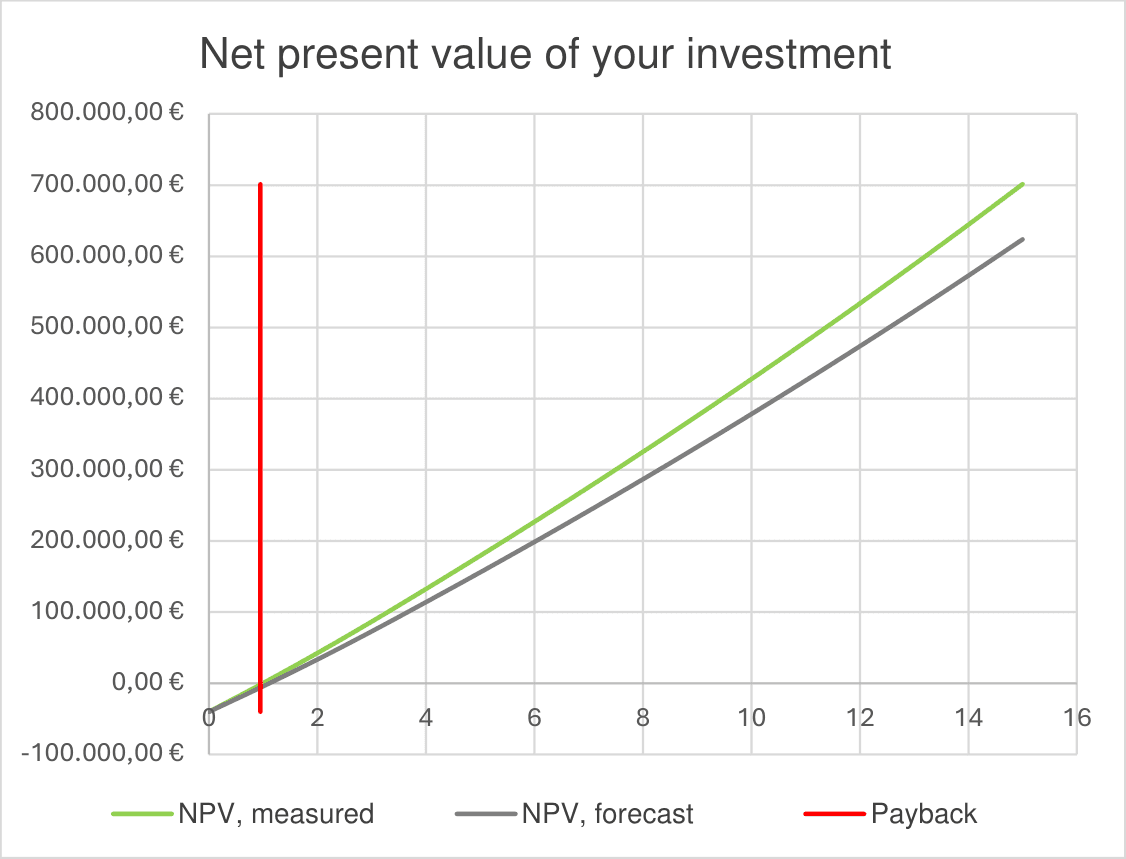
- > €701,000over the remaining service life of the plant.
- Primary energy saving
- > €37,800 p.a.at constant output.
- Payback (ROI)
- under 12 months(achievable at short notice, without a budget-intensive major investment).
- Cost of Delay
- Avoidance of a liquidity loss of approx. €3,157 per month through immediate implementation.
- Freedom from damage
- 100 % damage-free integration downtimes.
1. Initial situation & challenge
Production operations and the processing industry are subject to enormous cost pressure while facing uncompromising requirements for security of supply. The boiler plants for heat and steam generation form the energy backbone here.
In practice, however, conventional boiler systems reach a physical limit – the thermodynamic gap. Incomplete heat transfer in the combustion chamber leads to excessive flue gas temperatures, unnecessarily high cycling rates and inefficient fuel consumption.
The conventional solution – a structural retrofit or complete replacement of the plant – is often ruled out by the technical management. The reasons: high CapEx requirement (capital expenditure) and the unacceptable risk of incalculable plant shutdowns.
Never touch a running system!
2. The solution - minimally invasive integration (HTC)
To remedy this inefficiency without structural intervention, the thermodynamic retrofit procedure of Intensatec was applied in the present case. Custom-made high-temperature ceramics (HTC) are integrated minimally invasively into the combustion chamber of the existing boiler plant.
This physical modification fundamentally changes the radiation dynamics inside the boiler chamber.
- Heat transfer: The ceramic elements absorb the energy of the flame and radiate it in concentrated form onto the water-bearing boiler walls.
- Cycling rate reduction: The boiler holds its temperature significantly longer, which drastically reduces the energy-intensive, constant switching of the burner on and off.
- Emission reduction: Optimised combustion and reduced cycling rates lower the output of CO₂ and NOₓ measurably.
3. The proof - hard facts from industrial practice
Current measurement data from industrial practice prove that this thermodynamic effect works in practice and translates into hard cash flow.
In all measurements carried out to date on boiler plants up to 110 °C flow temperature, results between +10 % and +17 % were achieved.
The forecast of 12.00 % for the plant presented here was clearly exceeded, with an actual heating oil reduction of 13.61 %.
4. Installation and verification with full security of supply
For industrial production lines, an interruption of process heat is absolutely unacceptable. Installation into the existing boiler is carried out minimally invasively.
In hot water boilers (up to 110 °C flow temperature), the decisive proof of efficiency is provided by a TÜV-validated measurement procedure directly during ongoing operation and takes only two to three hours before and after installation. (Note for steam boilers: here the optimisation potential is determined by means of a well-founded, individual thermodynamic plant analysis).
The measure is contractually secured. Should the savings calculated in advance not be achieved during the measurement, the client has the right to a fair renegotiation or to damage-free removal with refund of the purchase price. To date, however, this option has never had to be exercised.
5. Conclusion
Before industrial companies consider CapEx-intensive new acquisitions, a thermodynamic look at the existing plant is worthwhile. Anyone who unlocks their unused boiler potential makes a substantial contribution to ESG targets and immediately protects their budget against the price spiral of CO₂ and energy costs.
Validated measurement report (anonymised)
The following extract from our original measurement report documents the effectiveness of the HTC integration in black and white. For your commercial assessment, these three factors are particularly decisive:
1. Optimisation of the cycling rates (burner running time)
Constant switching on and off consumes the most energy. The measurement report shows that the burner running time in the comparison cycle could be reduced from 64 minutes to 58 minutes. The boiler holds the heat considerably longer.
2. Reduction of the flue gas temperature
The temperature at the chimney fell from 122.75 °C to 118.50 °C. The heat is now transferred to the boiler water in concentrated form by the ceramic instead of escaping unused.
3. Hard ROI through primary energy saving
System efficiency rose from 6.970 kWh/m³ to 8.068 kWh/m³. This corresponds to an increase in energy yield of 15.75 %. The actual reduction in oil consumption, adjusted for weather and consumption, is 13.61 %.
Extract from the measurement protocol
(Plant: hot water boiler, heating oil H, 320 - 1965 kW)
Meter readings and efficiency (comparison over a 225-minute measurement cycle):
| Measurement run | Heating oil | Heat quantity | Efficiency |
|---|---|---|---|
| Measurement run 1 (without installations) | 36.00 litres of heating oil | 250.94 kWh heat quantity | 6.970 kWh/m³ |
| Measurement run 2 (with HTC installations) | 32.30 litres of heating oil | 260.61 kWh heat quantity | 8.068 kWh/m³ |
- Confirmed increase in energy efficiency
- 15.75 %
- Actual reduction in heating oil consumption:
- 13.61 %
Emission reduction (in relation to the real mass):
| Emission | Reduced by |
|---|---|
| CO₂ (carbon dioxide) (linear to oil consumption) | 13.61 % |
| CO (carbon monoxide) | 13.61 % |
| NOₓ (nitrogen oxides) | 34.69 % |
Economic efficiency calculation:
- Fuel costs p.a. (net)
- €278,388.00
- Consumption reduction p.a. in the 1st year
- €37,888.61
- Payback of the system
- after 0.95 years
- Calculated cost saving (15 years)
- €655,223.47
Translation of the German original. The German original, which you can open as a PDF above, is the authoritative version.